

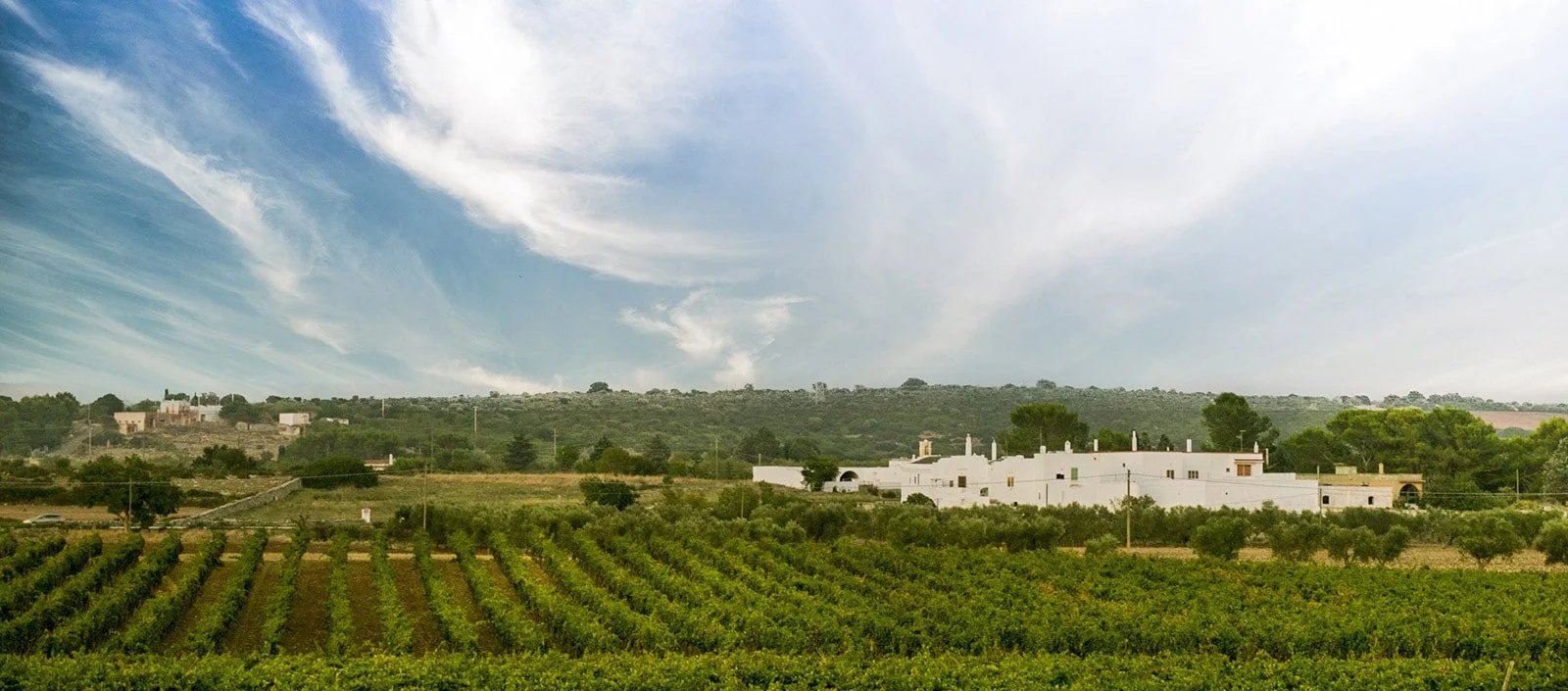
new arrivals: valle del monastero, tommaso cappa, petracavallo, davide xodo, fora
*
new arrivals: valle del monastero, tommaso cappa, petracavallo, davide xodo, fora *
VALLE DEL MONASTERO - Pantelleria, Sicilia
On the southwestern side of Pantelleria, in the Zighidì area, lies a valley heavily shaped by volcanic activity and caldera formations. It makes for a sheltered agricultural area with soils of sand, clay, and the local pumice-based SokiSoki formations. Its protected position creates a cooler and more humid microclimate compared with more exposed areas of Pantelleria, allowing the Zibibbo grapes to ripen gradually.
From the rooms of an old convent, the Valenza family has owned and managed this estate, aptly named Valle del Monastero, since the 1970s, dedicating its production primarily to Moscato and Passito. After a period of dormancy, the winery has found new life through Paolo Valenza. Following his oenology studies he gained experience with Occhipinti and later at De Bartoli's Bukkuram estate on Pantelleria. During an event on the island, Paolo met chef and winemaker Lorenzo Raffaglio, who, after working alongside François Rousset-Martin and Fabio Gea, was presenting wines from his own Alcamo project. (Lorenzo also owns Isola, a wine bar in Copenhagen.)
What began as a chance encounter quickly evolved into a shared vision. United by common values and a deep affection for Pantelleria, Paolo and Lorenzo officially relaunched the estate in 2024. Today they farm three hectares of vineyards, guided by principles of sustainability and a profound respect for the island and its unique viticultural heritage.
Their Sotto Costa Zibibbo is our primary offering. We also have very limited quantities of Vara, a rosato made from Nerello Mascalese and Grenache, and Tempra, a Passito di Pantelleria. Later this year, we'll also receive Tartisa, a semi-carbonic rosso of Grenache and Syrah.
Davide Xodo is based in Nanto, among the Colli Berici hills near Vicenza in Veneto, the land where he was born and raised. After more than 15 years in the wine world — studying oenology in Toulouse and working in Bierzo and for nearly a decade in Chianti Classico — he returned home in 2018 to establish his own estate.
His vineyards lie on the eastern slopes of the Colli Berici, a landscape shaped by ancient sediments and limestone rich soils. He works a number of small plots, many surrounded by woods, where he grows Tai Rosso, Garganega, Tai Bianco, Pinot Bianco, Malvasia Istriana, Merlot, Carmenère, Cabernet Franc, and Syrah.
As of the 2024 vintage, Davide has moved all operations into a new cellar: a former pasta factory that he restored and thoughtfully repurposed. His wines continue to evolve with each vintage, and after visiting and tasting earlier this year, it was clear that he has taken another significant step forward. He is becoming a winemaker fully in command of his vision, his vineyards, and the expression of his ideas.
PETRACAVALLO - Mottola, Puglia
Petracavallo is a family-run winery led by Vito D’Onghia and his late father, Peppino, in the countryside surrounding Mottola, in the heart of Puglia’s Murge plateau. The estate takes its name from the historic Petra Cavallo farmhouse, which is now home to three related families, including the D’Onghias. Its history dates back to the early 1800s and, according to local lore, perhaps even further to 1220, when legend holds that Saint Francis of Assisi stopped at the masseria on his return journey from Egypt.
Although wine has been made on the property since 1995, Petracavallo as it exists today was founded in 2015. Inspired by the wines his grandfather shared with him as a child, Vito set out to create wines that captured the same sense of place and authenticity: honest, artisanal expressions rooted in local tradition. To bring this vision to life, he partnered with his father, Peppino, whose decades of experience provided the foundation for the winery’s work until his untimely passing this summer.
Today, Vito farms five hectares of native Puglian varieties including Verdeca, Bianco d’Alessano, Fiano Minutolo, Negroamaro, Primitivo, and Montepulciano. We have been proud to work with Petracavallo for many years and are delighted to welcome their latest vintage.
TOMMASO CAPPA - Dogliani, Piemonte
Tommaso and Agnese, an oenologist and an architect, share a deep connection to the hills of Dogliani. Their work is guided by respect for the area's natural state and viticultural history. Originally from Torino, they spent years living and working abroad before returning to Italy with a vision of creating something deeply rooted in the land. In 2020, they established their winery in Dogliani, beginning with a small vineyard of Dolcetto and Barbera. When we first met Tommaso a few years ago, much of his time was spent working with more established nearby wineries, leaving less room to devote himself fully to his own project. Today, there is a clear sense of focus and commitment behind his personal endeavor, and that renewed dedication is reflected in the wines themselves.
The winery is located on the hill of Valdibà, one of Dogliani's final ridges before the landscape gives way to the rolling hills of the Alta Langa. This tiny hamlet consists of just three homes and a single winery. What began in a modest 40 square meter cellar is now evolving, as Tommaso and Agnese restore the property's historic barn into a new winery that will support their future ambitions.
Their vineyards surround the village, with southwest facing exposures that benefit from plenty of afternoon sun. Most parcels are within walking distance of the cellar, with a handful of smaller sites just beyond. The soils here form a complex mosaic of clay, silt, and sand over limestone.
They produce a flagship Dogliani DOCG alongside Langhe Nebbiolo DOC, Barbera, a Vino Rosso made from the local Neretta Cuneese, a sparkling Dolcetto rose, and a Langhe Rosato DOC of Dolcetto.
While we eagerly await the arrival of the rest of the lineup, we are pleased to introduce their Langhe Rosato DOC, produced from 45-65 year old Dolcetto vines planted at 370 meters above sea level.
Born out of necessity and from a desire to avoid waste, this wine gives new life to grapes removed during the summer green harvest. Instead of discarding them, Tommaso and Agnese vinify these clusters separately, transforming excess fruit into a wine with purpose.
Very close to Davide Xodo, both geographically and personally, Fora is a small grower project based in Nanto, founded by Giovanni Bottazzi and Simone Fanton. Their work is dedicated to rediscovering the identity of the Colli Berici through old vineyards of Garganega and Tai Rosso, with just 1.3 hectares of vines dating back to the mid-1980s.
Giovanni and Simone, the latter a highly regarded sommelier, are both deeply involved in the local winemaking community. Their friendship predates wine, rooted in a shared passion for cycling, which has become a lens through which they interpret their winemaking. Their sparkling wine takes its name from the cry heard during the Tour de France as thirsty riders call for a bottle from their teams: “Bidon! Bidon!” Their still Tai Rosso, meanwhile, mirrors the explosive final sprint of a cyclist: a burst of energy and intensity, the Bagarre, over almost as quickly as it begins.

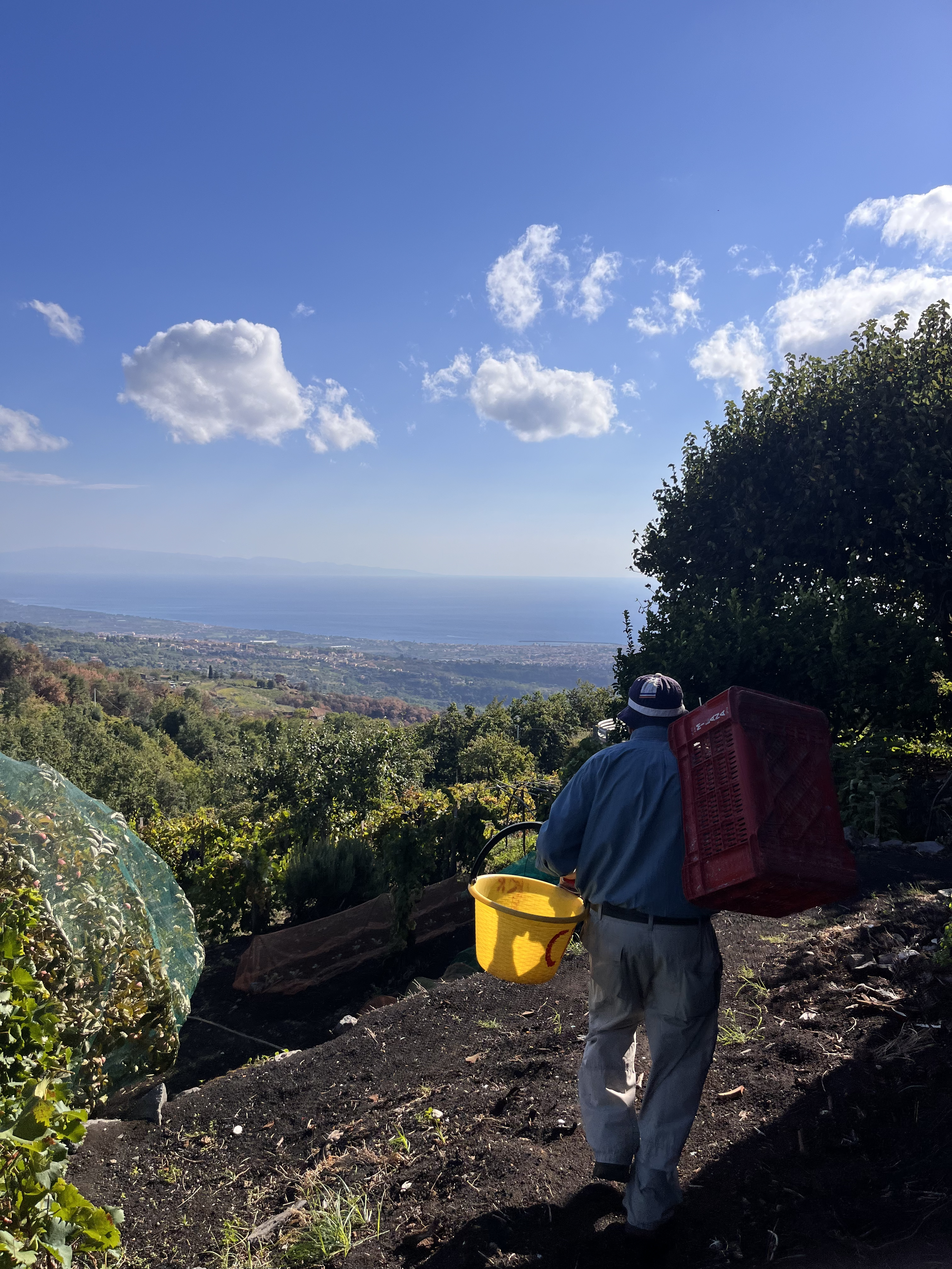
davide bentivegna: etna’s rare animal
*
davide bentivegna: etna’s rare animal *
Only from a distance could Ulysses look back and take in the vast, smoking slopes of Etna, and comprehend the magnitude of his enterprise, nodding to one of his friends, perhaps, and understanding for the first time the extent of the dangers they had undergone.
It must feel like that sometimes for Davide. Working day after day during growing season on the active volcano, feeling its rumble beneath his steps, hearing it roar and gurgle, sometimes waking in the night to see lava exploding into the night sky and spilling down the slopes, silently hoping it will spare his terraced vines.
And yet, after all the challenges of the season, navigating the mountain’s whims, and coaxing life from the volcanic soil, it is only in the quiet of the cellar — tasting with a friend, perhaps — that he fully realizes the scale of his achievement and the extraordinary gift of crafting wine on Etna for yet another vintage, of being around to taste it yet another year.
Davide snaps out of the story for a moment, as Etna sputters smoke into the air. Fire and myth, he says, remind us that life on this volcano has always demanded intelligence as much as strength: to navigate its smoke-filled craters, boiling lava fields, and its legendary threats, survival required quick thinking, daring, and a sharp mind. It is a mountain that tests all who encounter it, where every triumph — whether escaping a giant or harvesting from its jagged volcanic soils — is earned through wit as much as will.
On the steep terraces that climb up the northern slope of the volcano, as high as 1000 meters above sea level, Davide wanders amidst his vines, greener and lusher than you would expect from a land this warm, like a legendary creature from another time, a rare animal hopping between his several contrade or crus. Davide’s viticulture is careful and tiresome.
Davide’s favorite part of the myth is its ending, the escape. As Ulysses and what remained of his crew reached their ships and began to row to safety, Polyphemus, realizing he had been outwitted, hurled massive boulders into the sea, sending waves crashing around the fleeing ships. Sicilians recognize these boulders in the small ‘Cyclopean Isles’ off the coast of Catania, silent monuments to Ulysses’ life-saving cunning.
Davide Bentivegna knows the story of Ulysses on Mount Etna and he likes to recount it as we stroll through his alberello vines.
On the rugged coast below the volcano, Ulysses and his men once sought refuge after years at sea. Above them rose the mountain, smoking and restless, long believed to be the fiery forge of the cyclopes, where the one-eyed giants shaped thunderbolts for Zeus in chambers of molten stone.
It was there, in a cavern carved from black volcanic rock, that they encountered Polyphemus, the fiercest of them all. He led a tranquil life, herding sheep by day and drinking their milk by night, but when these strangers entered his cave, he turned violent. With a boulder rolled across the entrance, Ulysses and his crew were sealed inside, forced to watch as the giant began devouring them one by one.
Ulysses, ever cunning, chose wit over force. He poured the cyclop cup after cup of dark, intoxicating wine — a gift carried from his travels — until his single eye grew heavy and finally closed. In that silence, Ulysses and his men drove a burning stake into the monster’s brow. Responding to his cry, the other cyclopes moved the boulder to come to his help, while, clinging to the bellies of Polyphemus’ sheep, Ulysses and his crew slipped past the stone and out into the light…
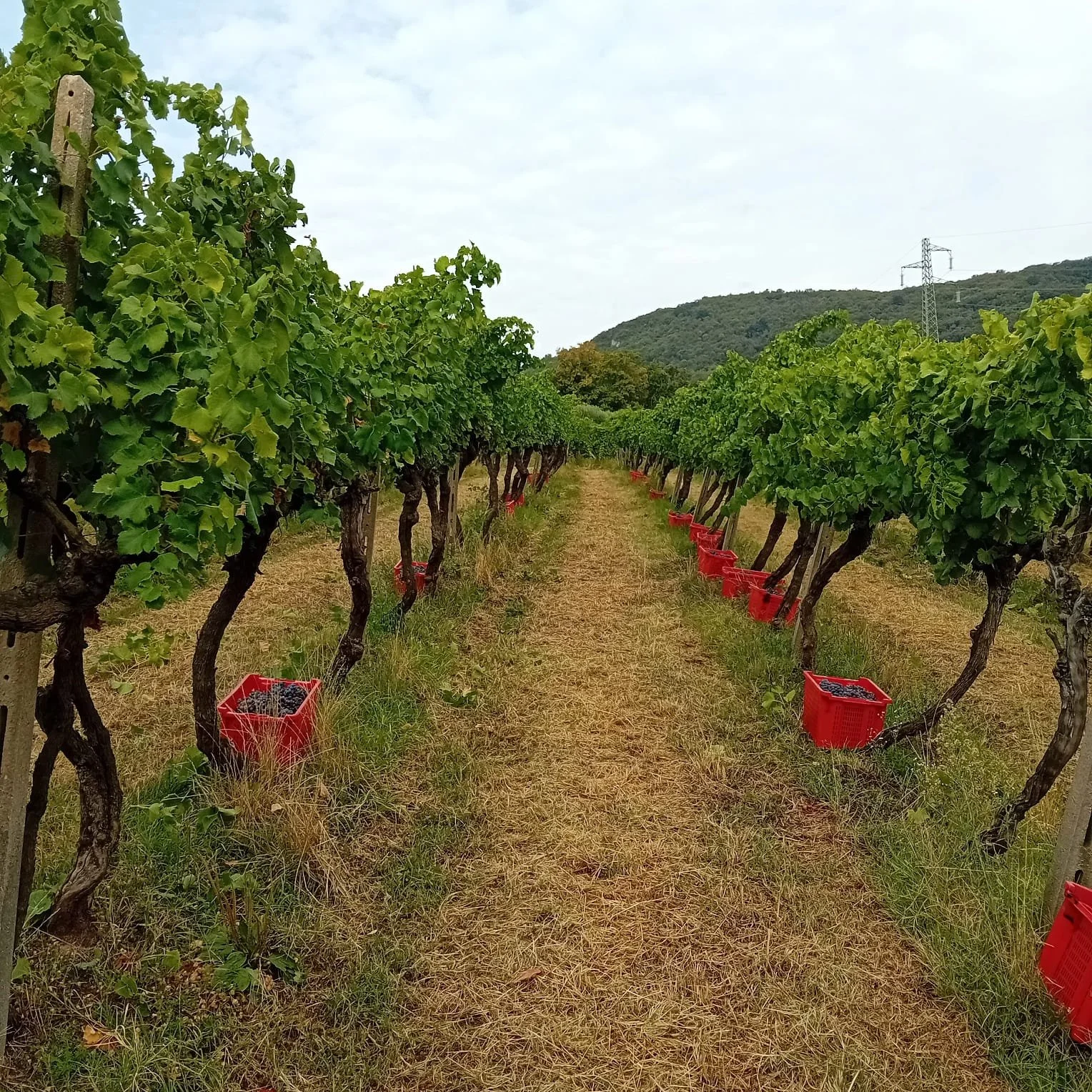
2025 harvest report
*
2025 harvest report *
GROWING SEASON IS NEVER FREE OF TROUBLE AND ITALY HAS HAD SOME PRETTY CHALLENGING YEARS OF LATE AS FAR AS CLIMATE AND DISEASE ARE CONCERNED, BUT THE YEAR 2025 MAY SURPRISE US WITH A HISTORIC VINTAGE!
Let’s explore it: From North to South…ish.
In Breganze (Veneto), our friends at Rarefratte, Cristian and Arianna, just started harvesting last Sunday. The growing season was smooth up to July 20th, then hail came…followed by a lot of rain. Luckily they didn’t lose too much crop, but the 2025 will probably produce wines that will be low in alcohol and high in acidity…can’t be too mad at that…
Over in Nanto, still in Veneto, Fora is definitely feeling climate change. For the first time ever they started harvest as early as August 20th. Still, the growing season was good: a warm spring, and a very warm June with little rain…maybe too little for the Garganega, which felt the stress in a few plants, while the Tai Rosso didn’t seem to mind. Then, finally, it rained for a whole day (40 mm) on August 2nd “a beautiful slow rain, it felt like fall,” says Giovanni, and then the scorching sun again, giving Fora fully mature and heavy clusters. “The grapes are beautiful,” Giovanni concluded, “with beautiful color and beautiful skin.”
Moving West to Modena, there too, harvest started 15 days earlier than usual. In spite of this, Claudio Plessi is hopeful for what he believes is a promising new vintage. While we wait for this vintage to follow its course, we are about to welcome a shipment of Claudio’s wines to New York this very week. His Lambruscos and other sparklings stole everyone’s heart the first time around (and so did his still reds), and an even larger line-up will be sure to blow you away with its sparkle. More soon…
In Lazio, just outside of Roma, Riccardo Magno of La Torretta is similarly excited.He tells us that he hasn’t seen grapes as good looking as this year’s in many many years, but, he says….”let’s not jinx it!” The growing season this year did not bring as many challenges as the last, allowing Riccardo, who farms biodinamycally, to reduce treatments to a minimum (only 800gr of copper per hectare). The grapes have been harvested, and Riccardo says, “they are gorgeous, ready to ferment.”
All the way down to Sicily, now, where 2025, Fabio Signorelli tell us, will be a complex year to decipher. Different microregions, and even different vineyards within the same areas, had to face different challenges throughout the growing season. The last couple of years vineyards across theMediterranean witnessed vicious attacks of pathogenic funghi. This year, the peronosopora first attacked as early as March, but Fabio, who had a hunch, was able to brace his vineyards for impact and save them from a tragic destiny. Then, the heat came, and with it, easier conditions. The grapes now look “crunchy and healthy.” Harvest will start tomorrow for his rosato, while for the reds he will wait until October.
These are just some of the news from the many corners of Italy where our producers are working with, sometimes against, the challenging condition of a fast-changing environment to deliver excellence for yet another year. It is hard to capture the excitement in their voices and their words when they tell us about the year’s adventures…most times, from our New York offices, we just have to wait until we can uncork those time capsules that we call a bottle of wine and sample what it meant to toil, hope, experiment, despair, rejoice, and hardly ever rest for a whole growing season, all the way to harvest.
Here’s to another vintage…in bocca al lupo!
On to Piemonte. It was a year of experimentation in La Morra at Borgogno Rivata. For the first time, their Arneis, which still hasn’t debuted on the American market, was harvested in two phases: one earlier for higher acidity, and another about 10 days later for fuller ripeness. Winemaker Giovanni Mingolla will be playing with oxidation and aging under flor for this one, but it will take a while before we will be able to bring you the end result of this experiment. On the next shipment from the guys at Borgogno Rivata, however, you can expect a new favorite, Lumas, the latest addition to the Borgogno Rivata line-up: 80% Pelaverga and 20% Dolcetto. Aged in cement only, it is extremely vibrant and crunchy. A perfect option for a fresh red by the glass.
On the other side of La Morra, the growing season held a few challenges, with a hard-to-manage alternation of intense heat and strong rains. Towards the end of the growing season, however, Renato Molino’s vineyards were blessed by some very cold nights, ideal for the ripening of Nebbiolo and promising for the future of their Barolos. While their first shipment to the US, carrying the 2019 vintage will land in the fall, “our fingers are crossed,” says Chiara (Renato’s daughter), for a 2025 that promises low quantities and very high quality.
From Barolo to Barbaresco, Marco Viglino of La Vedetta had a sleepless night last week when a terrible storm swept over their hill, “but fortunately no hail, thank God!,” he told us. Harvest is yet to start, but 2025, says Marco, is definitely promising. A lot of water was left in the soil from last year and thanks to a sunny spring and summer, the grapes were able to ripen well, without any illnesses: “they look just great!” His Barbaresco will come to New York in the fall, and so will his Freisa (yes, exciting!) and his Barbera and…we just can’t wait!
Over in Roero, Lorenzo Negro was happy to be able to work with a few more collaborators in the vineyards this growing season, which allowed him to come to the point of harvest with “some truly stunning plants.” Lorenzo’s wines will land in New York for the first time in the next couple of days, and we couldn’t be more excited to welcome to the city the soul of Roero. To some, Roero is still a mystery, but the true connoisseurs of the bel paeseare not sleeping on this microregion were Nebbiolo and Arneis DOCGs produce outstanding wines year after year. Lorenzo, who has trained generations of young Roero winemakers, tells us that the 2025 is meeting all the parameters to become one of the "great vintages of Roero.”